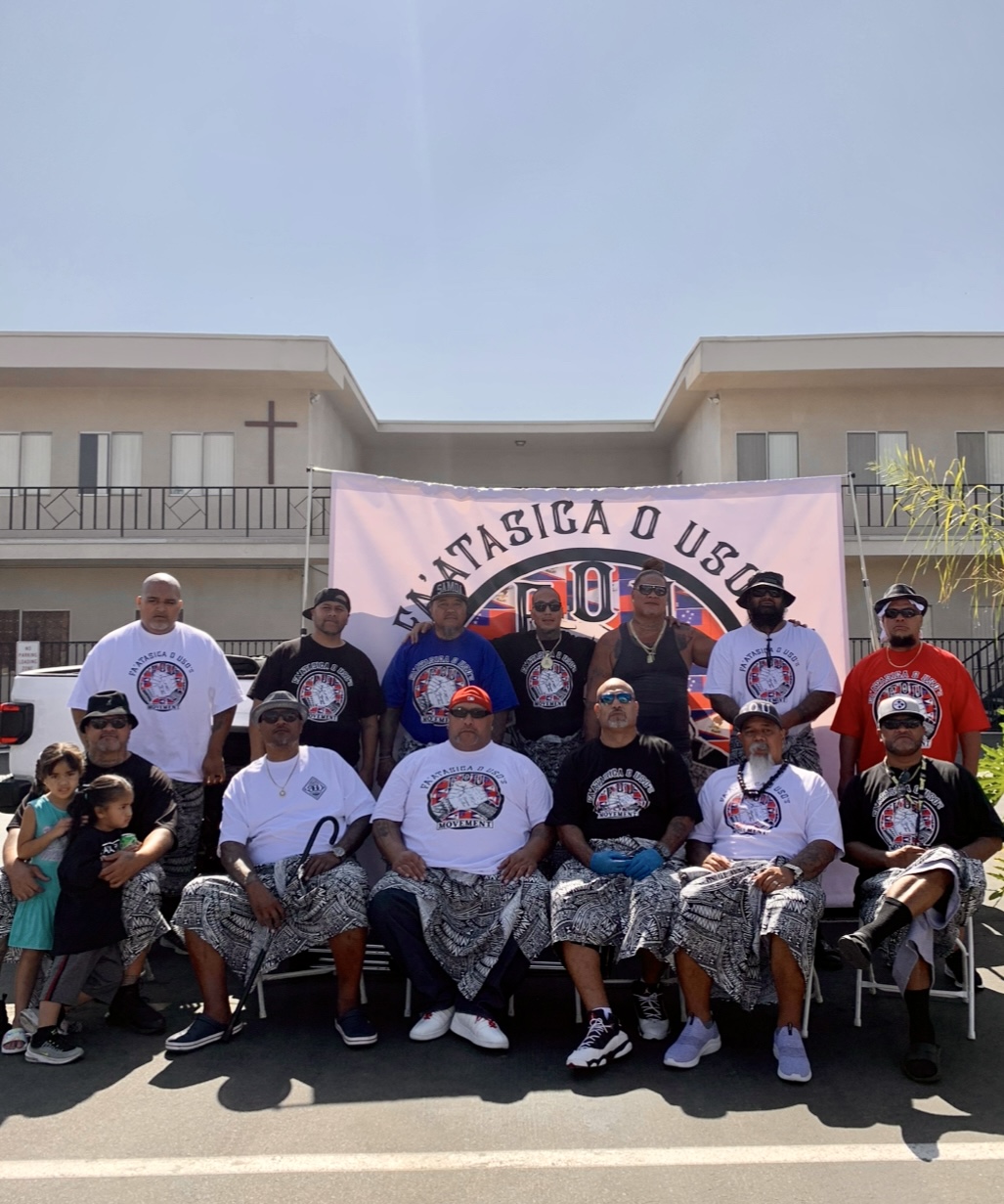
Founded and operated by formerly incarcerated Pacific Islanders, FOU (which stands for “Faatasiga O Uso,” or “The Gathering of Brothers” in Samoan) Movement is a We Got us Fund grantee that offers youth outreach, addiction recovery, and reentry support across Southern California. We sat down with founder and vice chairman Tino Luafalemana to talk about how it all started and why people with lived experience are some of our most powerful community leaders.
Q: Can you take us back to the beginning? How did FOU Movement start?
There wasn’t a big plan in the beginning. My main intention was to stay connected with my usos (brothers) from prison. When we reconnected on the outside, I sent daily devotionals. I did that for a while until my daughter Chelseay suggested I make a group chat instead of texting everyone individually. It grew from there, and eventually, we decided we needed to do something different for the kids – something to help them make better choices than we did.
We created three departments based on our experiences: reentry, youth outreach, and addiction recovery. Growing up in Carson, I made some bad decisions in my life and have lived all three: juvenile hall at 15, over 10 years in prison, and addiction. I dealt with addiction and, by the grace of God, I’ve been clean since July 2019.
Years later, everything still starts in our Monday meetings: we bounce around ideas and figure out how to make them happen.
Youth conference in Carson with API RISE. Photo: Tino
Feeding the community under the bridge in Long Beach. Photo: Tino
Q: How has your personal journey shaped your role in FOU and your work today?
My sobriety is a huge part of both my journey and work today. I never thought I’d get clean. I grew up during the pop-locking and breakdancing era, which eventually gave way to the gang era in my neighborhood. The older generation was heavily involved in gangs, so joining the local gang felt like the norm.
My lifestyle of partying and drinking to selling drugs, and eventually using, spiraled out of control. I had the same choices everybody else had – education, sports – but at the time, hanging out, drinking, and following in my older brother’s footsteps seemed more appealing.
I got sober in prison and went to rehab for the first time in July 2019. There, I learned about the disease of addiction, healthy coping skills, and setting boundaries. I carry these lessons into my work with FOU.
In 2022, I became a certified drug and alcohol counselor. Now, I work at an outpatient center and also previously worked at Pacifica House, where I got clean. It was a full circle moment.
My passion is helping people recover from drugs and alcohol. It’s said that the disease of addiction promises us three things: jails, institutions, and death. I’m here to be of service to others. If I’m able to help one person recover from drugs and alcohol, a part of my work is done. It’s about saving one soul at a time.
#ReleaseMN8 campaign organizers rally in front of the U.S. Immigration and Customs Enforcement building in St. Paul, MN, seeking to deliver signed petitions calling for the release of the MN8 men on November 3, 2016. Photo: Thaiphy Phan-Quang
Q: What does true community safety mean to you?
True community safety, at its peak, means a decline in drug addiction and gang-related deaths in our community.
One of the Carson sheriffs told Nelson Saole, a member of FOU Movement, that Polynesian-on-Polynesian crime has decreased since the movement began. Back in the day, usos from different neighborhoods like Carson, Compton, and Long Beach didn’t get along. A lot of us were taught to dislike people based on color or where they came from. But in prison, we had no choice but to come together. When we were released, we carried this new mindset with us back into our communities.
This shift makes a difference, especially for our youth. Many of us have long-standing respect in our neighborhoods, so when young people see us who are familiar faces coming back not to fight, but to serve, it sends a powerful message.
We tell them: you don’t have to join a gang. You can make a different choice. You can choose peace. FOU Movement is helping us unlearn and find healing.
Distributing toys in Compton during Christmas. Photo: Tino
Q: How has FOU helped create safety in ways traditional systems haven’t?
The safety we’ve created comes from the love we show each other. Usos still caught in gang mentality see how we’ve changed—how we get along now—and it’s contagious. They see former gang members who used to be at odds working side by side, joking about how things used to be. That love and change are powerful, and they trickle down and outwards. Our job now is to plant and water the seeds.
At one high school, a teacher invited us to speak in a law-themed classroom. Before us, the only guest speakers were cops or corrections officers. After we shared, a ninth grader shared that he’d been thinking about joining a gang, but after listening to us, he decided not to do it. And he wasn’t even Polynesian. That showed me how far our reach goes.
Talking to the youth at Carson High School. Photo: Tino
Q: From your perspective, what are some of the biggest needs in the community right now?
One major need is continuing the work of bringing real peace to our communities. We’ve earned respect because people know our past, and they see the change. When we show up for the youth, the formerly incarcerated, and those struggling with addiction, it’s clear we’re doing it from a place of love.
We also need more voices from the AANHPI community speaking openly about issues like addiction. By breaking the silence, we can help reduce the stigma and encourage more people to seek support and consider rehab. Addiction is a real issue in our communities, but it is still very taboo. We avoid talking about it or reaching out for help, but that silence kills us.
In all my time working in treatment, I’ve only seen a handful of AANHPI folks come through. That’s why I’m so open about my recovery. I want people to know it’s okay to ask for help.
Q: What would it look like for society to invest in formerly incarcerated leaders?
It would look like us. Our lived experience matters, and we reach youth in a deeply personal way to help them make better life choices. Someone’s advice can impact you differently if you know they’ve walked in your shoes. Like Peter Afemata would say, “People don’t care how much you know until they know how much you care.” We show how much we care by being transparent with our own stories. You don’t have to go to prison to learn to love your brother. We show that now in our daily lives here, where people receive direction and guidance from our own lived experiences.
Talking to the youth at Cabrillo High School in Long Beach. Photo: Tino
Donation drive for the fire victims in Pasadena and Altadena. Photo: Tino
–
First and foremost, I want to thank God and my Higher Power, whom I choose to call Jesus Christ, for blessing me with a life I never thought possible.
My name is Valentino “Tino” Luafalemana, and I’m the founder and vice chairman of FOU Movement. I’m married to my beautiful wife, Carissa Cabezas Luafalemana, and together we have a blended family of ten kids and five grandchildren.
Today, I work as a drug and alcohol counselor. I believe it’s my calling to help others suffering from the disease of addiction and to share resources with those who need them. I’m passionate about being of service to my community, and I’m honored to do this work alongside my USOs from FOU Movement.
Much love and respect to my brother, Antonio “Big Tone” Luafalemana, who passed away on July 6, 2024 – your spirit lives on in everything we do. LONG LIVE BIG TONE.
Rest in peace to Ross Maseuli – forever remembered.
And rest in peace to Pastor Pa’e Satele – thank you for the daily devotionals you shared with me in the beginning. Your guidance helped lay the foundation for this journey.
Learn more about FOU Movement and support their work at www.foumovement.org.